TikTok trends that ruin teeth: what cannot be undone
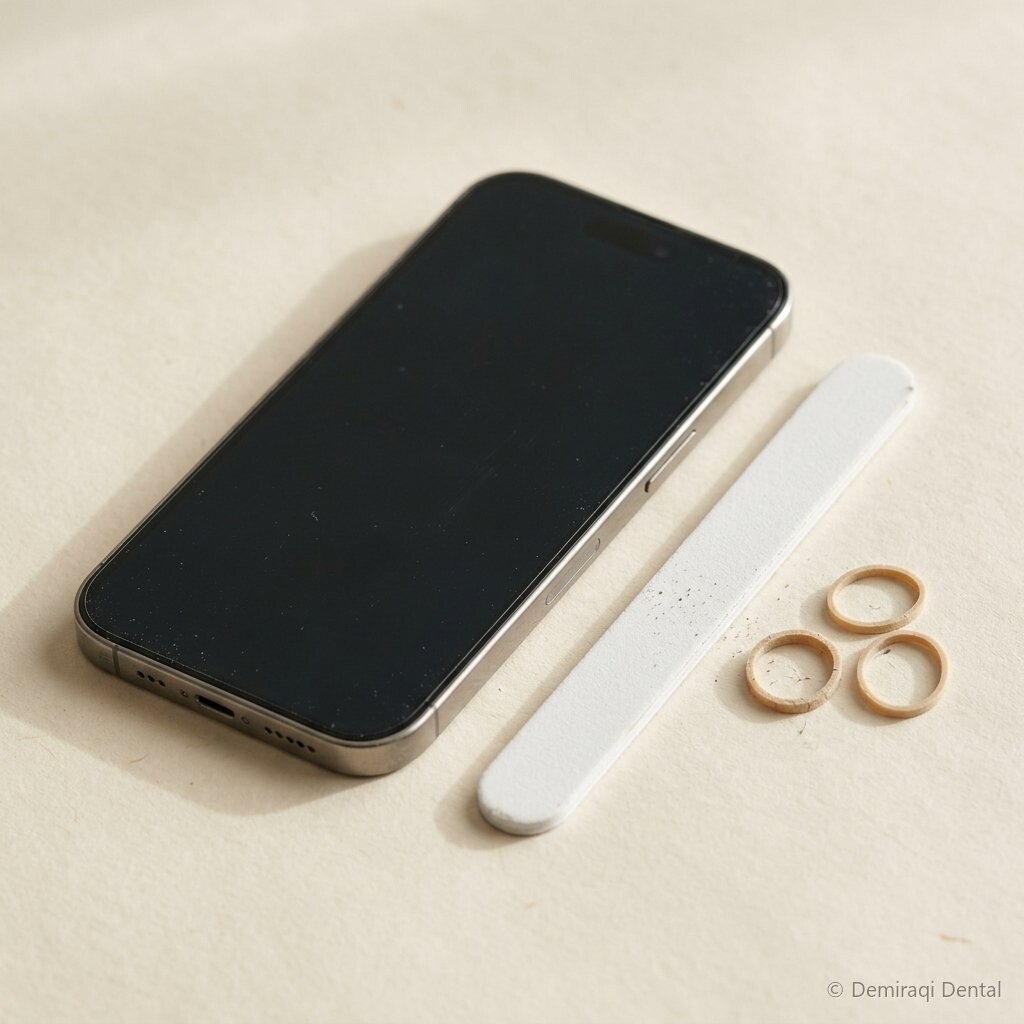
Some of them look harmless: a rubber band, a nail file, a sponge. The others look serious, because they happen in a clinic, with a gown and a light overhead. All five have one thing in common — they take away something that does not come back. A rubber band, a nail file, a phone. […]
Some of them look harmless: a rubber band, a nail file, a sponge. The others look serious, because they happen in a clinic, with a gown and a light overhead. All five have one thing in common — they take away something that does not come back.
A tooth does not grow again
Skin is cut and heals. Bone breaks and knits. Tooth enamel does not. It is formed once, before the tooth comes into the mouth, and that is the end of it. Whatever is taken off it is gone for good.
So with teeth the first question is not “will it look good” but “how much is removed, and can it come back”. The five trends below are ordered from the mildest to the most serious. They all follow the same road.
1. Rubber bands to close a gap between the teeth
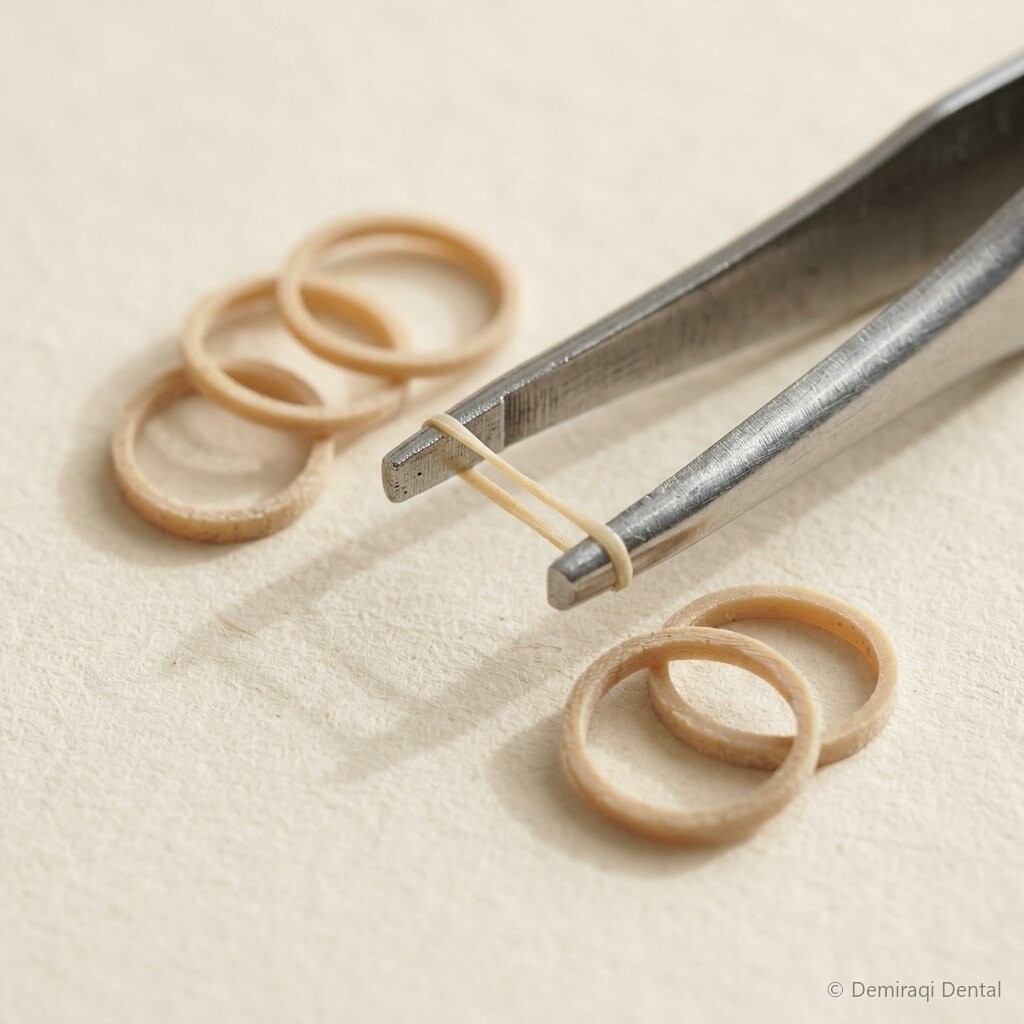
A band is put around the two front teeth and left there. The gap seems to close within days. That speed is exactly the sign that something is wrong.
The band does not stay where it is put. It slides down, under the gum, and goes on squeezing where it cannot be seen or felt. The American Association of Orthodontists has issued a public warning about precisely this: the band can cut off the blood supply to the root, and the tooth is lost permanently. There are published cases in which teeth had to be removed, children included.
And even if the gap closes, what caused it is still there: the bite, the size of the teeth, the room they have in the arch. The teeth drift back, or a new gap opens somewhere else.
2. Filing teeth with a nail file
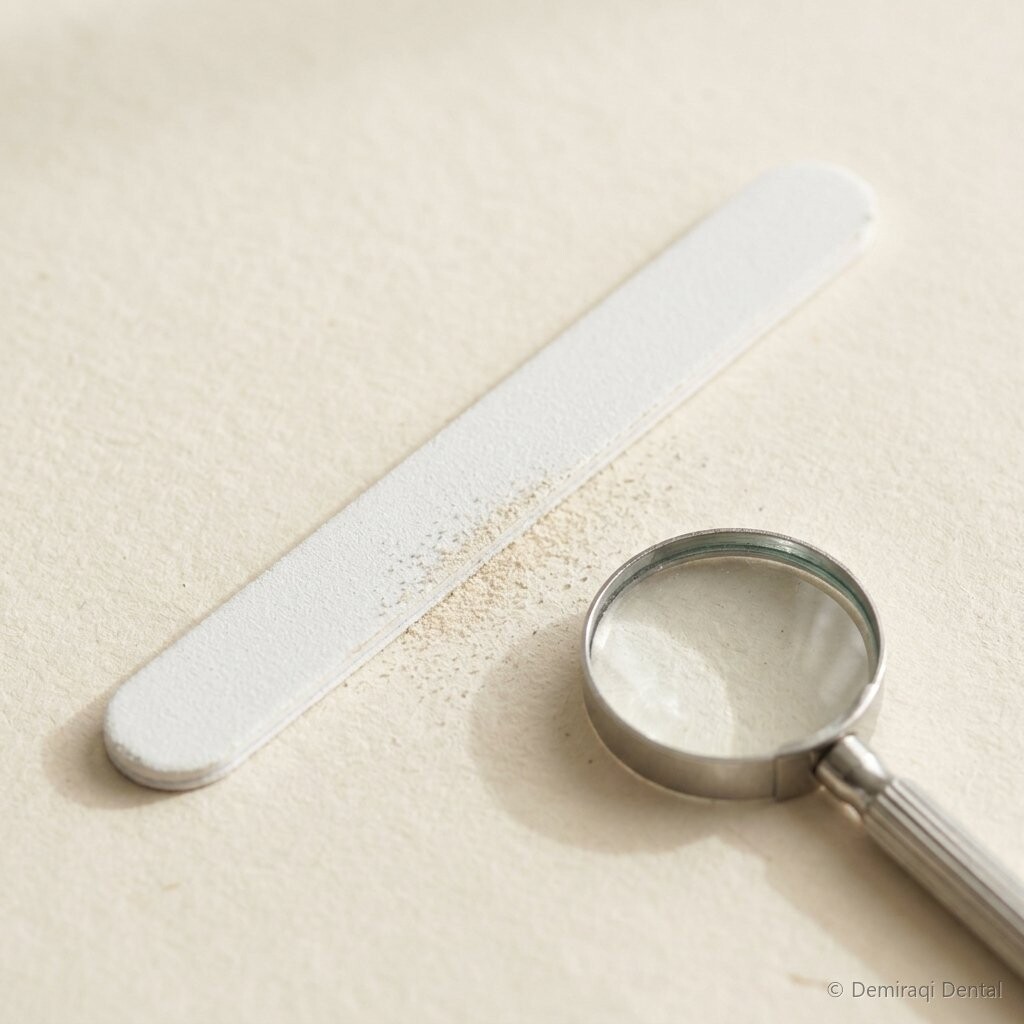
Upper teeth are never exactly alike. Filing their edges with a nail file makes them look level within minutes.
The enamel at the biting edge of a front tooth is thin. Underneath it is dentine, which is softer, more yellow and connected to the nerve. Once the enamel is gone, the tooth starts to feel cold, then sweet, then it aches for no visible reason. The British Dental Association’s scientific adviser has said it plainly: filing permanently damages the structure of the tooth and makes it more prone to decay.
There is a consequence people do not expect. A filed edge does not stay smooth — it stays rough and holds plaque, in the one place that shows most.
Reshaping a tooth exists as a real procedure and is done at the dentist. The difference is that there the thickness of the enamel is measured and the bite is examined before anything is touched.
3. Whitening with things that are not meant for the mouth
Two are the most common: strong hydrogen peroxide put straight onto the teeth, and the white household cleaning sponges.
The cleaning sponge is melamine foam. Wet, it behaves like very fine sandpaper. The tooth does go whiter — because its surface is being rubbed away. The packaging of these products says not to use them on skin.
With peroxide the question is not yes or no, but how strong and under what supervision. Professional whitening is also based on peroxides. The difference is the concentration, the time, the protection of the gums, and an examination before it starts. High concentrations applied at home burn the gum, leave white patches, and leave teeth that ache.
One more thing has to be said: not every yellow tooth whitens. If the colour comes from the dentine, from an old root canal treatment or from a filling, whitening does not touch it. That is something an examination shows, not a video.

4. Crowns on healthy teeth
This is the trend that has picked up the nickname “Turkey teeth” online, because it is often tied to travelling abroad. But the problem is not the country — it is the procedure, and it is done everywhere.
Many people believe they are getting veneers. A veneer is a thin layer bonded onto the front surface, and it keeps the enamel. A crown is a different thing altogether: the tooth is reduced all the way around, from every side, until a small cone is left. Most of a healthy tooth is taken away.
After that there is no going back. A reduced tooth will always need a crown over it. When the first crown comes off after a few years — and it always does — a second one is made, over a tooth that is already smaller than before.
There are immediate consequences too. To make the result look as attractive as possible, these low-cost centres reduce the tooth deeply, and that brings it close to the nerve. Dentists who treat these patients report teeth that die, root canal treatments that should never have been needed, abscesses, and inflamed gum around crowns that do not seal well at the margin.
The largest survey on this, run by the British Dental Association among more than a thousand dentists, found that 95% of them had seen patients treated abroad and 86% had had to treat complications. The treatment most often needing to be redone was crowns.
5. Removing healthy teeth
This is the last step on the same road, and the most serious. The patient is offered the removal of teeth that are still healthy, in order to place implants or a full bridge — often with the argument that it finishes faster, or that it comes out looking better.
Implant specialists in the United States have spoken publicly about it: perfectly healthy teeth are being taken out. One dental school dean, after giving second opinions to dozens of patients who had been recommended implants, found that most of the teeth could have been kept.
An implant is a good and necessary treatment when a tooth cannot be saved. It is not an upgrade on a tooth that can. Your own tooth, even with a filling, even with a root canal treatment, has something an implant does not: the ligament that joins it to the bone and that feels the force of the bite.
And one simple thing: a removed tooth does not come back. The bone that held it begins to shrink within the first months.

What is done instead
For each of these trends there is a real route, and none of them is new.
Gaps and crooked teeth — orthodontic treatment, with fixed braces or clear aligners, after an assessment that includes radiographs and a look at the bite. It takes months, not days. That is not a shortcoming of the method; it is the time the bone needs to adapt.
Uneven edges or small teeth — reshaping at the dentist, or rebuilding with composite, which is added onto the tooth and takes nothing off it.
Colour — a professional cleaning first, because a good part of the yellowness is surface staining. Then controlled whitening, if the examination says it makes sense.
Changing how the smile looks — veneers that preserve the enamel exist and are a recognised procedure. The question to ask the dentist is simple: how many millimetres are removed, and is my own tooth still underneath.
Why it matters who does the work
Dentistry has specialties, just as medicine does. Moving teeth is the orthodontist’s work. The gum and bone that hold them are the periodontist’s. The root and the nerve are the endodontist’s. Surgery is the maxillofacial surgeon’s. Each of them has years of study after the dental degree, not a course.
The difference is not in the hand. It is in what is seen before the tooth is touched. A gap between the teeth is not only a gap — it is the bite, the arch, the bone and the joint. A shortened tooth is not simply shorter — it changes how the teeth meet when you close your mouth. Someone who has seen this hundreds of times knows what moves along with it. Someone who has not finds out later.
So the question “who will do it” is not rude. It is an ordinary question, and any good clinic answers it without irritation: who does it, what they trained in, and whether the case needs more than one doctor. Complicated cases are not solved by a single name — they are solved by a plan in which each person does their own part.
Three questions before you accept a treatment plan
1. What is taken off my tooth, and does it come back? Ask for the answer in plain words. “A little” is not an answer.
2. Why this treatment and not a smaller one? If a crown is proposed, ask why not a veneer or composite. If removal is proposed, ask why the tooth cannot be saved.
3. Who deals with it if something goes wrong, and when? Every treatment needs follow-up. A plan with no follow-up is not a complete plan.
If a plan has to be accepted the same day, that in itself is a reason to wait. A second opinion costs nothing. A reduced tooth does.
If you are unsure
If you have tried one of these and now feel pain, sensitivity or bleeding gums, do not wait. The sooner it is seen, the less has to be removed.
If you are considering a large treatment — here or abroad — and want someone to look at it before you begin, write to us or call us.
[email protected] · +355 67 566 9542 · +355 4 2230703